Crawl Space Moisture Guide for Spartanburg's Red Clay Soil
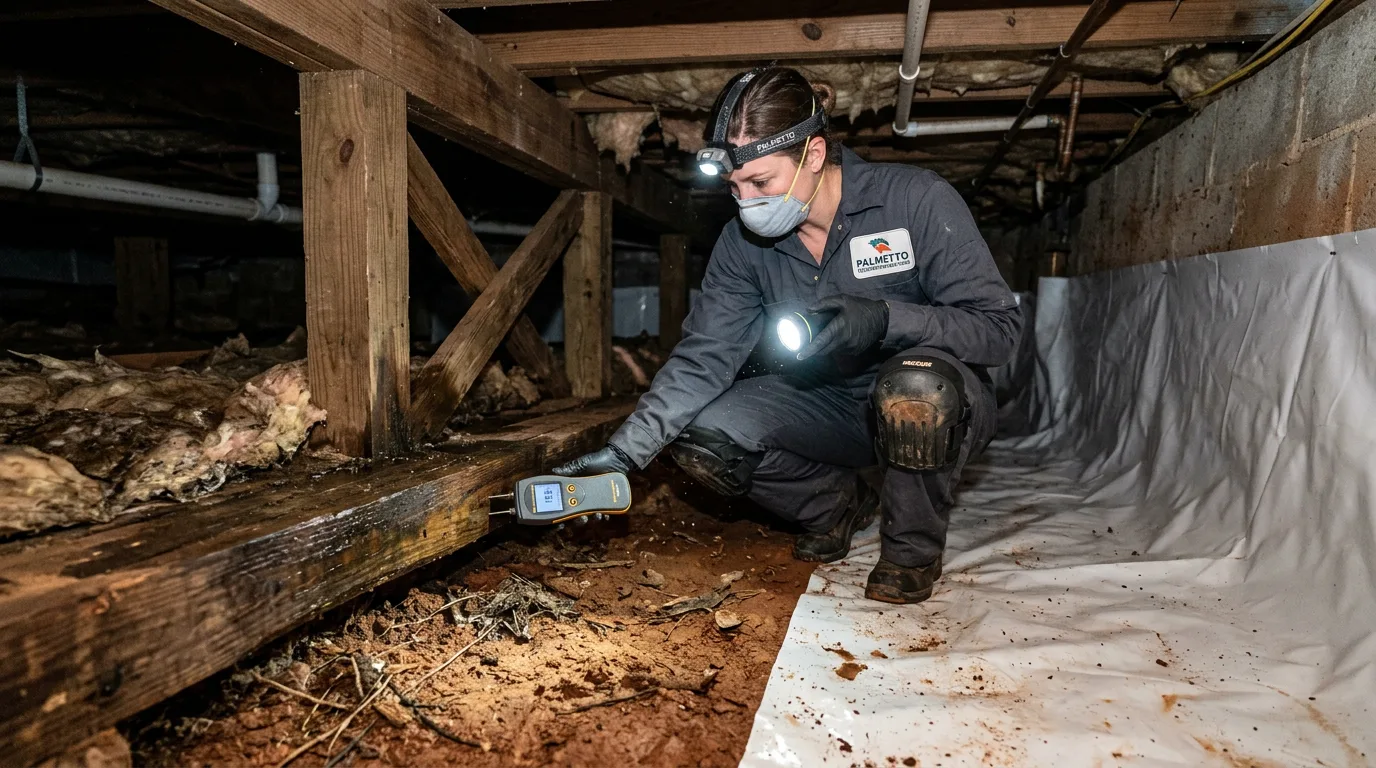
If you’ve noticed a musty smell coming up through your floors or found mold on the joists under your Spartanburg home, the culprit is almost certainly the ground beneath your feet. Crawl space moisture in Spartanburg’s red clay soil is one of the region’s most chronic and underestimated home maintenance problems — and it’s fundamentally different from crawl space moisture in other parts of the country.
In this post, we cover why Spartanburg’s Piedmont red clay creates conditions that ordinary vapor barriers can’t manage, what the signs of crawl space moisture look like, and what a proper encapsulation system does to solve the problem permanently.
Free Crawl Space Inspection in Spartanburg
We assess moisture levels, identify sources, and provide encapsulation options with transparent pricing. Call (888) 376-0955.
Why Spartanburg’s Red Clay Soil Creates Chronic Crawl Space Moisture
The Piedmont red clay soils that underlie most of Spartanburg County behave very differently from the sandy or loamy soils found elsewhere in South Carolina. Red clay has a low permeability rating — it drains slowly, holds water after rain events for extended periods, and expands when wet and contracts when dry in a cyclical pattern that generates persistent movement and pressure against the structures it surrounds.
After a typical spring thunderstorm in Spartanburg, the clay soil around a home can remain near field capacity — the point at which it can hold no more water — for two to three weeks. During this period, the soil continuously pushes moisture against foundation walls, crawl space piers, and through the ground surface into the crawl space atmosphere. This isn’t a single water event followed by drying; it’s a sustained moisture load that keeps crawl space humidity elevated long after the rainfall that caused it has passed.
The expansive nature of red clay adds a second problem: as the soil repeatedly swells and contracts with moisture cycles, it generates lateral pressure against foundation walls and vertical movement against slab and pier footings. This movement can crack mortar joints and create new moisture pathways that didn’t exist when the home was built. Older properties throughout Spartanburg County — particularly in Hampton Heights and other neighborhoods developed before 1960 — show this pattern of progressive moisture pathway development.
What Happens Inside an Unencapsulated Crawl Space
Most pre-1990 homes in Spartanburg were built with vented crawl spaces — foundation vents designed to allow outside air to circulate through the crawl space and carry moisture away. This approach works reasonably well in dry climates. In Spartanburg, where summer outdoor air contains more moisture than the crawl space air, vented crawl spaces actively introduce humidity into the space during the months when moisture risk is highest.
The result is a crawl space where mold growth on floor joists and subfloor is not a failure condition — it’s an expected outcome of the building method in this climate. Wood in contact with crawl space air at Spartanburg’s typical summer humidity levels will sustain active mold colonization indefinitely. Fiberglass batt insulation between joists absorbs moisture, loses its R-value, and eventually drops out of position, leaving the floor above without thermal protection.
Structural drying within an unencapsulated, vented crawl space is also extremely difficult because the outdoor air being introduced through the vents continually adds moisture. Professional drying equipment in such a space must work against a nearly unlimited moisture supply from both the soil and the outdoor air.
Concerned About Your Spartanburg Crawl Space?
Our team inspects crawl spaces throughout Spartanburg County and provides honest assessments with no pressure to buy. Call (888) 376-0955.
Signs Your Crawl Space Has a Moisture Problem
Musty smell: The most common indicator — a persistent musty odor rising through floors into living space indicates active mold growth on joists or subfloor. This smell is often strongest in rooms directly above the crawl space and in early morning when the house has been closed overnight.
Soft or bouncy floors: Subfloor damage from chronic moisture presents as soft spots or increased flex when walking. Joists that have absorbed moisture repeatedly become permanently weakened even after drying.
Condensation on pipes and ducts: Visible condensation on pipes or HVAC ducts in the crawl space indicates that surface temperatures are below the dewpoint of the crawl space air — a reliable indicator of excessive humidity.
Visible mold on joists or sill plates: White, gray, or black discoloration on wood surfaces in the crawl space. In Spartanburg’s climate, any visible mold in a crawl space should be treated as an active colony requiring remediation.
High indoor humidity: Crawl space moisture actively contributes to whole-house humidity levels through the stack effect — the natural air movement from lower to upper levels of a home. Homes with unsealed crawl spaces in Spartanburg typically run 5–10% higher indoor humidity than encapsulated homes during summer.
Rust on steel components: Metal fasteners, HVAC equipment, and ductwork in the crawl space showing rust or corrosion indicate sustained elevated humidity exposure.
Types of Crawl Space Moisture Solutions
Heavy-duty vapor barrier: A 12–20 mil polyethylene sheet sealed to the foundation walls and at all seams, covering the entire crawl space floor. The barrier breaks the soil-to-air moisture transmission pathway. This is the foundation of any encapsulation system.
Crawl space dehumidifier: A commercial-grade dehumidifier sized for the crawl space volume. Unlike household dehumidifiers, crawl space units are designed for continuous operation in restricted spaces and drain automatically. In Spartanburg’s climate, a dehumidifier is not optional — the ambient outdoor humidity is too high for a vapor barrier alone to maintain dry conditions year-round.
Perimeter drainage channel: In cases where groundwater actively enters the crawl space — as opposed to vapor transmission through the soil — a perimeter drainage channel routes liquid water to a sump basin before it can spread across the floor.
Sump pump system: A sump basin and pump collect and discharge groundwater that enters the crawl space drainage system. Required in homes with active groundwater intrusion from Spartanburg County’s saturated red clay soil.
Joist and sill plate repair: Structural wood that has been damaged by chronic moisture — soft spots, delamination, or mold penetration — must be repaired or replaced before encapsulation begins. Encapsulating over damaged structural wood locks in the problem.
How the Crawl Space Drying and Encapsulation Process Works
Our crawl space drying process follows a specific sequence that ensures the encapsulation system performs correctly from the day of installation. First, we perform a complete moisture assessment — mapping moisture levels in the soil, air, and structural wood throughout the crawl space. Any standing water is extracted, and damaged materials including old vapor barrier, wet insulation, and mold-affected wood are removed.
Industrial dehumidifiers and air movers are staged in the crawl space for active drying, with daily moisture readings tracking progress. We do not begin encapsulation until structural wood moisture content reaches acceptable baseline levels — installing a vapor barrier over wood that is still above baseline moisture traps the moisture in place and perpetuates the problem.
After the space reaches target moisture levels, the encapsulation system is installed: vapor barrier first, then drainage infrastructure if needed, then the permanent dehumidifier. We provide complete documentation of pre- and post-installation moisture readings, which serves as both a performance baseline for ongoing maintenance and documentation for insurance purposes when moisture damage is part of a covered loss.
Cost of Crawl Space Encapsulation in Spartanburg
Crawl space encapsulation in South Carolina typically costs $4,500–$20,000 depending on the crawl space size, vapor barrier thickness, drainage infrastructure required, and dehumidifier specification. Most standard residential projects in Spartanburg County — a 1,500–2,000 square foot home with a moderately sized crawl space — fall in the $5,000–$9,000 range.
Projects in older Spartanburg neighborhoods like Converse Heights tend to run higher than new construction because they more frequently require structural pre-work — joist sistering, sill plate replacement, or mold remediation — before encapsulation can be installed. Our crawl space drying service page covers the full cost breakdown with Spartanburg-specific context.
Frequently Asked Questions
How do I know if my Spartanburg crawl space needs encapsulation?
Any crawl space with musty odors, visible mold, soft flooring, or high indoor humidity should be professionally inspected. In Spartanburg County, nearly all pre-1990 homes with vented crawl spaces will show some degree of moisture problem on inspection — the climate and soil conditions make it nearly universal. A free professional inspection gives you an objective assessment of severity and options.
How long does crawl space encapsulation last in South Carolina?
A quality vapor barrier typically lasts 15–25 years. The dehumidifier component requires annual maintenance — filter changes and condensate drain checks — to continue performing. Annual crawl space inspection is recommended to catch any barrier penetrations or drainage changes before they compromise the system.
Can I encapsulate my crawl space myself?
Basic vapor barrier installation is within reach of skilled DIYers, but the moisture assessment, drainage design, and dehumidifier sizing require professional knowledge to get right. An improperly sized dehumidifier or a barrier that doesn’t seal correctly at seams and walls provides minimal benefit. We recommend professional installation for Spartanburg County crawl spaces given the clay soil conditions and typical moisture loads involved.
Fix Your Spartanburg Crawl Space Permanently
Call (888) 376-0955 for a free crawl space inspection. We serve Spartanburg, Greer, Woodruff, and all of Spartanburg County.
Related resources: