IICRC Certification: Why It Matters for Spartanburg Water Damage
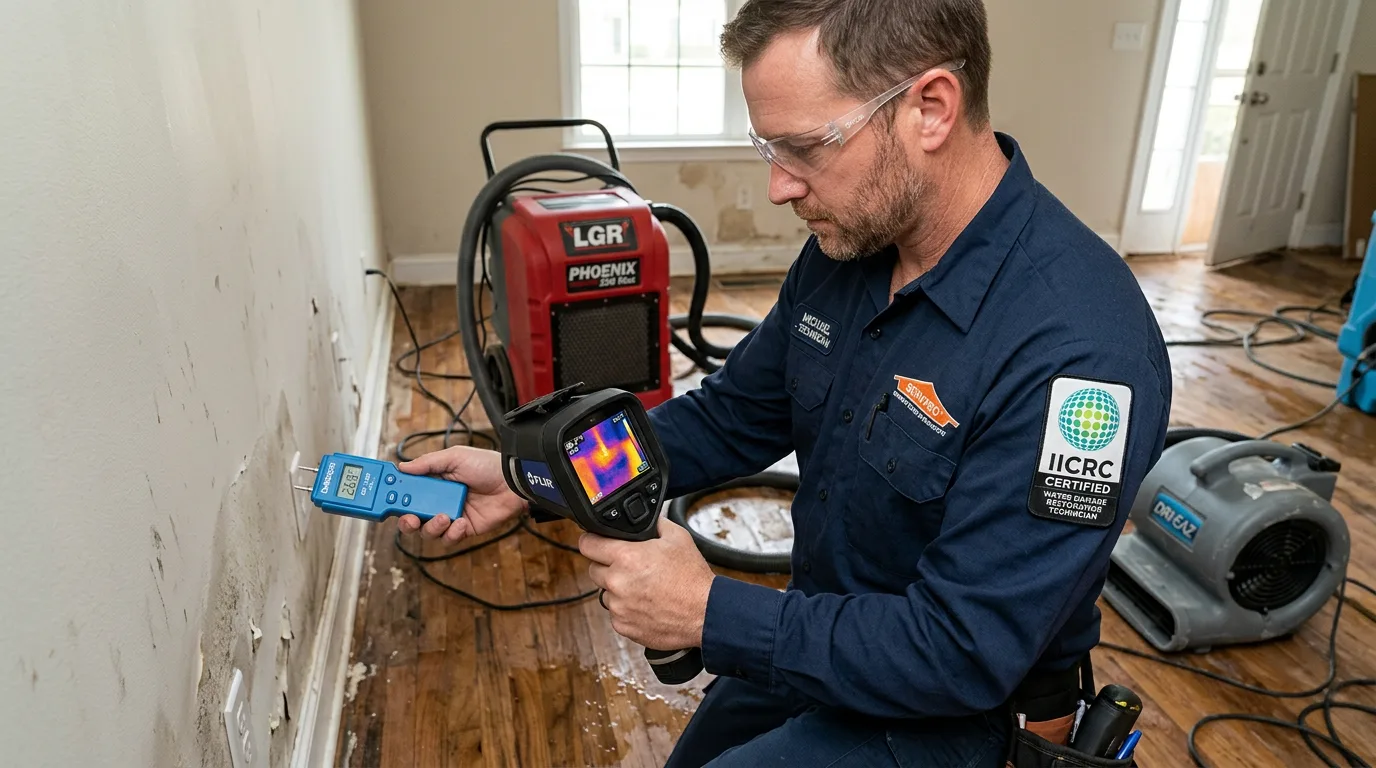
When Spartanburg homeowners search for water damage restoration, the acronym “IICRC” appears in nearly every company’s marketing. But most homeowners don’t know what it means, whether it matters for their specific situation, or how to verify it. IICRC certification for Spartanburg water damage restoration companies is not just a credential — it is the difference between a technician who follows a documented, scientifically validated restoration protocol and one who uses visual assessment and gut feel to make decisions that affect the structural integrity of your home.
In this post, we explain what IICRC certification actually means, what the S500 and S520 standards require, and why the standards are particularly important for Spartanburg’s high-humidity climate.
IICRC-Certified Water Damage Restoration in Spartanburg
Certified technicians, documented protocols, complete insurance documentation. Call (888) 376-0955.
What IICRC Stands For and What Certification Means
IICRC stands for the Institute of Inspection, Cleaning and Restoration Certification. It is the international body that establishes standards for the inspection, cleaning, and restoration industry — including the two standards most relevant to water damage restoration:
ANSI/IICRC S500 — Standard for Professional Water Damage Restoration: Governs the inspection, water extraction, structural drying, and documentation protocols that define professional water damage restoration. S500-certified technicians understand how different materials absorb and release moisture, how to use moisture meters and thermal imaging equipment to assess the full scope of a loss, and what moisture baseline levels must be reached before structural enclosure is safe.
ANSI/IICRC S520 — Standard for Professional Mold Remediation: Governs the containment, removal, cleaning, and clearance testing protocols that define professional mold remediation. S520-certified technicians follow documented containment procedures, HEPA removal protocols, and clearance testing requirements that protect both building occupants and remediation workers.
To earn IICRC certification, technicians must complete formal training courses and pass written examinations. Certification must be maintained through continuing education. This means certified technicians have demonstrated knowledge of industry standards, not just experience doing the work.
Why IICRC Standards Matter More in Spartanburg
The IICRC standards were developed for national application, but several elements of the S500 standard are particularly relevant in Spartanburg’s climate:
Psychrometric principles in high-humidity environments: The S500 standard includes extensive guidance on how to use drying equipment in high-ambient-humidity conditions — exactly the scenario Spartanburg presents during summer months when outdoor humidity exceeds 70%. An S500-certified technician knows how to configure dehumidifiers and air movers to create effective drying conditions even when the ambient air is nearly saturated. An uncertified technician running standard air movers in a Spartanburg summer without proper dehumidification is largely wasting the client’s time and money.
Thermal imaging requirements: The S500 standard specifies that thermal imaging should be used to assess moisture migration beyond visible damage. This is not a suggestion — it is a protocol requirement for certified work. In Spartanburg homes where water routinely migrates from upper floors into crawl spaces or from crawl spaces into floor assemblies, thermal imaging is often the only way to detect the full extent of a loss.
Moisture documentation requirements: Certified work requires daily moisture meter readings at all documented measurement points, with readings logged and retained as project documentation. This documentation is what insurers use to verify that drying was completed properly — and it is the evidence that supports insurance claims when the project duration is longer than insurer tools predict (which happens frequently in Spartanburg’s climate).
Category and class determination: The S500 standard requires that every water damage project be categorized (1/2/3 based on contamination) and classified (1–4 based on evaporation rate) before a drying plan is developed. Category and class determine the appropriate drying protocol — using a Category 1 protocol on a Category 3 loss produces an unsafe outcome, and using a Class 1 protocol on a Class 4 loss produces an incomplete drying result.
Certified Water Damage Restoration — Spartanburg SC
IICRC S500 and S520 certified technicians for every project. Call (888) 376-0955 for 60-minute emergency response.
What IICRC Certification Means for Your Insurance Claim
Insurance adjusters are familiar with IICRC standards and use them as the basis for evaluating restoration scope and cost. When a certified company provides documentation that follows IICRC protocols — moisture logs, daily readings, psychrometric calculations, scope-of-loss reports — adjusters can validate the restoration scope against the standard. When an uncertified company provides informal notes or no documentation, adjuster validation is more difficult and disputes are more common.
In Spartanburg County, where summer climate conditions can extend drying timelines beyond what national insurance cost estimation tools predict, S500-certified documentation that explains the extended drying period in technical terms is often essential for supporting the full claim amount.
How to Verify IICRC Certification in Spartanburg
IICRC certification can be verified through the IICRC’s public directory. When contacting a water damage restoration contractor in Spartanburg, ask:
- Are your technicians IICRC certified?
- For which standards (S500, S520)?
- Can you provide your certification number for verification?
A legitimate certified company will provide this information without hesitation. Vague responses like “we follow IICRC guidelines” without specific certification numbers indicate that formal certification may not exist. The distinction matters because IICRC guidelines are publicly available — following them is different from having passed the certification examination and maintaining active certification status.
The Difference IICRC Standards Make in Practice
Two scenarios illustrate the practical difference between certified and uncertified restoration work in Spartanburg:
Scenario 1 — Incomplete drying: An uncertified contractor extracts water, runs air movers for 3 days, and declares the job complete based on a dry-looking floor surface. Without moisture meter readings, they do not know that the subfloor and lower wall framing still read 18–22% moisture content — well above the 15% threshold for safe enclosure. Reconstruction begins over wet structural materials. Six months later, the homeowner discovers mold in the wall cavity. The reconstruction cost plus mold remediation cost significantly exceeds what proper initial drying would have cost.
Scenario 2 — Certified protocol: A certified contractor extracts water, documents moisture readings at all structural measurement points, stages appropriate drying equipment, and monitors daily until all readings return to pre-loss baseline levels (typically 10–14% for wood in Spartanburg’s climate). Reconstruction begins over properly dried materials. Six months later, no mold. Total project cost is higher than the uncertified contractor’s initial quote, but it is the right cost for the actual scope of work.
Frequently Asked Questions
How do I know if a Spartanburg water damage contractor is IICRC certified?
Ask for the technician’s IICRC certification number and verify it at the IICRC’s public directory. A legitimate certification is verifiable in real time. Do not accept verbal assurances alone — actual certification is a matter of public record.
Does IICRC certification affect insurance coverage?
Many insurance policies and adjusters require that restoration work be performed by IICRC-certified technicians to be covered. Even policies that do not explicitly require it recognize S500 documentation as the industry standard for validating restoration scope. Using a non-certified contractor can create coverage disputes when claims are filed.
What is the difference between IICRC S500 and S520 certification?
S500 governs water damage restoration (extraction and structural drying). S520 governs mold remediation (containment, removal, and clearance testing). A full-service water damage restoration company should have technicians certified in both, since mold remediation is often a component of water damage projects in Spartanburg’s high-humidity climate. Our mold remediation service page covers S520 protocols in detail.
IICRC-Certified Water Damage Restoration in Spartanburg SC
Our technicians are certified to IICRC S500 and S520 standards. Call (888) 376-0955 for 24/7 emergency response.
Related resources: